info@harmanismed.gr

CPR mannequins
The CPR Mannequins category includes educational models designed for training in cardiopulmonary resuscitation and emergency care. The mannequins allow for the practical application of chest compressions, artificial respiration and the use of defibrillators in realistic conditions. They are ideal for medical students, nurses, healthcare professionals and first aid teams. The equipment is made of durable materials and designed for repeated use, ensuring accuracy and reliability during training. The mannequins contribute to the development of skills that can save lives in real-life incidents. The CPR Mannequins category is an essential tool for anyone seeking excellent training in emergency care and resuscitation.
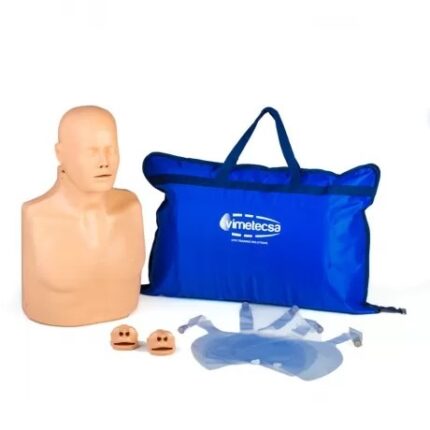
Adult & Child CPR Model PRACTI-MAN ADVANCE JAW THRUST
Adult & Child CPR Template PRACTI-MAN ADVANCE JAW THRUST new advanced model, by VIMETECSA, is the most complete First Aid training tool at the best possible price!
In addition to having the ability to simulate the chest compressions of adults and children, with the turn of a switch, the new PRACTI-MAN ADVANCE model can also be used to train the technique of traction of the lower jaw, also known as jaw thrust. A technique that very few educational models combine!
The PRACTI-MAN ADVANCE training model on its back has a three-position switch where each simulates different compressions. The first position simulates the depth of chest compressions required for a child. The second position simulates the depth of chest compressions required for an adult while the third position does NOT have any limitation in order to be able to, The trainee should test his skills in real situations in order to make sure that he has been trained appropriately.
The jaw thrust maneuver is a procedure used to prevent the airway from being blocked by the tongue. It is used in patients who suspect spinal injury and is used in unconscious patients. (see video tab with execution technique)
The injection system of the PRACTI-MAN is the most realistic on the market. There is a human-compatible connection of the air ducts. Nose, mouth, throat, and lung sac work together to perfectly simulate human functions. The air does not pass into the lung sac unless the head is properly lifted and the nose is not closed with the fingers of the trainee rescuer. The non-return valve to which the lung bag is connected does not allow material to be transferred from the bag to the trainee, making the Practi-Man the safest CPR model as the possibility of infection is eliminated.
In addition to having the ability to simulate the chest compressions of adults and children, with the turn of a switch, the new PRACTI-MAN ADVANCE model can also be used to train the technique of traction of the lower jaw, also known as jaw thrust. A technique that very few educational models combine!
The PRACTI-MAN ADVANCE training model on its back has a three-position switch where each simulates different compressions. The first position simulates the depth of chest compressions required for a child. The second position simulates the depth of chest compressions required for an adult while the third position does NOT have any limitation in order to be able to, The trainee should test his skills in real situations in order to make sure that he has been trained appropriately.
The jaw thrust maneuver is a procedure used to prevent the airway from being blocked by the tongue. It is used in patients who suspect spinal injury and is used in unconscious patients. (see video tab with execution technique)
The injection system of the PRACTI-MAN is the most realistic on the market. There is a human-compatible connection of the air ducts. Nose, mouth, throat, and lung sac work together to perfectly simulate human functions. The air does not pass into the lung sac unless the head is properly lifted and the nose is not closed with the fingers of the trainee rescuer. The non-return valve to which the lung bag is connected does not allow material to be transferred from the bag to the trainee, making the Practi-Man the safest CPR model as the possibility of infection is eliminated.
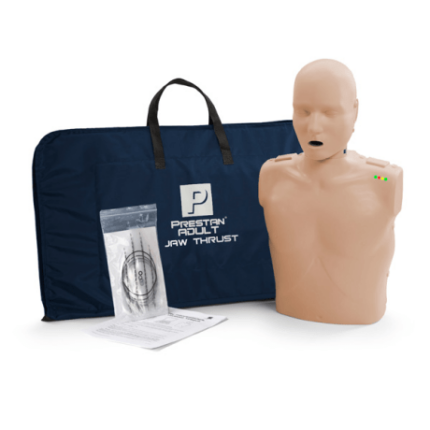
Adult Training Mannequin with LED Metronome & Carrying Bag Prestan Jaw Thrust
The Prestan Jaw Thrust Adult Mannequin is a unique tool for training the jaw thrust technique, also known as jaw thrust, while also being a CPR and Defibrillation training mannequin! This new and amazing product from Prestan looks and feels exactly like the company’s regular mannequin. The difference between these two mannequins is the left and right lower jaw. It is easy to use, allowing students to learn and understand how to properly perform the jaw thrust technique. The mannequin allows students to grasp the jaw and lift it with both hands, moving it forward and backward. The jaw thrust technique is the safest approach to opening the airway of a victim with a cervical or spinal injury because it can be achieved with minimal neck movement. Complete realistic training in CPR and AED with a training automated external defibrillator (AED TRAINER). Absolutely realistic model to the eye and touch. The PRESTAN ADULT Professional Adult Manikin is different from any other on the market as it has a luminous metronome indicating correct or incorrect chest compression rate and amplitude. Available for BLS / AED training purposes.
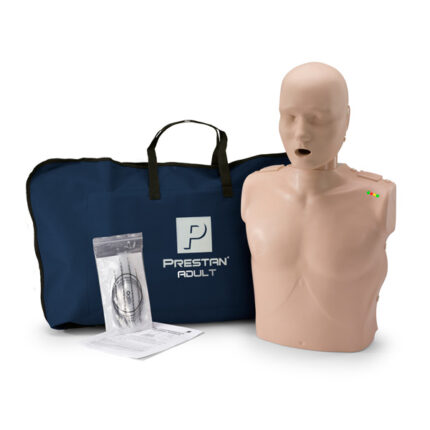
Prestan Adult First Aid Training Model with Metronome
Adult training manikin for use in CPR and First Aid. It is suitable for a comprehensive and realistic training in CPR and DEFIBRILLATION with an automated external defibrillator (AED TRAINER). Absolutely realistic manikin to the eye and touch. The PRESTAN ADULT Professional Adult Manikin is different from any other on the market as it has a luminous metronome indicating correct or incorrect chest compressions in rate and range. Available for BLS / AED training purposes.
THREE (3) YEAR MANUFACTURER'S WARRANTY
Finally, the skin of the PRESTAN ADULT manikin is ideal for defibrillation training with an automated external defibrillator as it has the property of protecting the electrodes from wear in every use.
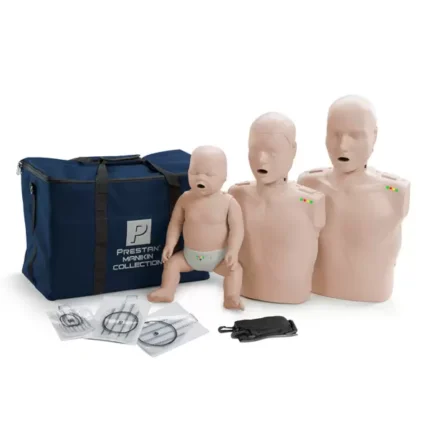
Prestan Educational Mannequin Pack (1 adult - 1 child - 1 infant)
The Prestan training manikin package includes 1 adult, 1 child and 1 infant manikin, all with an LED chest compression metronome. The package also includes 10 adult lung bags, 10 child lung bags, 10 infant lung bags, 1 instruction booklet and a carrying & storage bag. At the end of the seminars, trainers want their students to be able to calmly deal with an emergency situation. They want to be sure that students will be able to deal with a cardiac episode successfully. This can be achieved with Prestan professional manikins which have a new LED chest compression metronome. The LED metronome allows both the trainee and the trainer to check if the chest compressions are being performed correctly. For the instructor, it helps him to check the performance of his students with a quick glance from a distance, while for the trainee, he has immediate feedback, giving him information about whether he is doing the chest compressions at the right pace, thus helping him to improve his technique. The depth of the compressions is a crucial point in training as well. Prestan's models help in the correct learning of the depth of chest compressions thanks to the "click" sound that you hear when the chest compression is done correctly. So, when the chest compressions are done correctly (according to the ECC) then the trainee will hear the characteristic click sound. Therefore, the frequency and depth of chest compressions are the two most important things that the instructor must teach his students. Prestan models have the ability to provide immediate feedback, virtual and acoustic, in order to quickly improve the technique of the trainees.
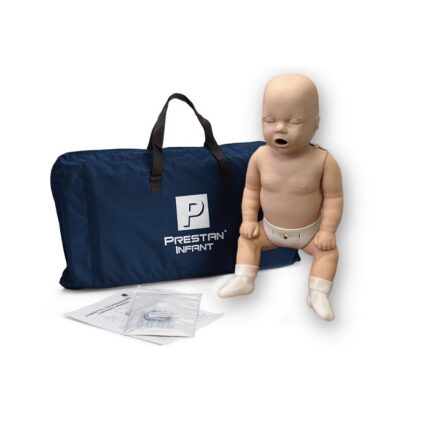
Prestan First Aid Infant Educational Model with Led Metronome and Carrying Bag
Prestan Infant First Aid Training Mannequin with Led Metronome and Carrying Bag realistic to the eye and touch. The professional infant mannequin is unlike any other on the market. Available for educational purposes, Prestan mannequins are uniquely designed as a "shell" in which either a face mask or a lung bag can be easily placed. The new revolutionary cardiopulmonary resuscitation (CPR) indicator display allows both the instructor and the student to be immediately informed about the percentage of chest pressure. This allows each student to measure the percentage of compressions on their own, as well as allowing the instructor to monitor multiple students simultaneously quickly and easily. Also, with the patented face/head tilt, the professional infant mannequin simulates the way a real victim's head would move if CPR was required. In addition, the unique construction of the manikins incorporates a mechanism to help use the right force to compress the chest to the right depth. The new model comes with new limbs. The model's legs include socks, while its arms move in all directions and not just up and down.
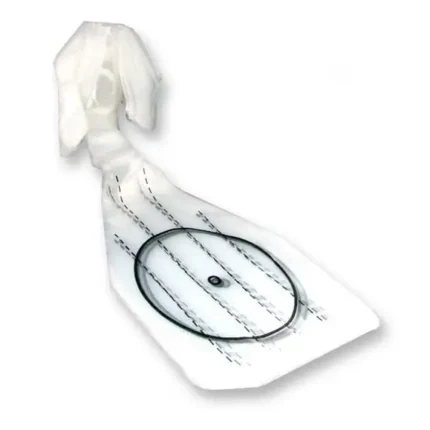
Replacement Lung Bags for Prestan Adult Model
Replacement lung bags for adult model, from Prestan company. Lung bags are used in educational models and simulate the ventilation function of a victim who is not breathing. It would be advisable to replace the lung bags after the end of a training seminar in order to ensure the hygiene of the trainees and prevent the transmission of diseases.
Replacement Lung Bags for Prestan Child Model
Spare lung bags for child model, by Prestan. Lung bags are used in educational models and simulate the ventilation function of a victim who is not breathing. It would be advisable to replace the lung bags after the end of a training seminar in order to ensure the hygiene of the trainees and prevent the transmission of diseases.